In the rapidly evolving landscape of corporate education, the debate regarding instructional designer vs learning designer has moved beyond mere semantics to a strategic talent decision. As organizations pivot toward skills-based hiring and digital transformation, understanding these roles is critical for building a high-impact L&D function. This guide provides a deep dive into the nuances of these roles to help you hire, train, and scale your learning operations effectively.
If you’re hiring for L&D or mapping your next role, the question instructional designer vs learning designer comes up fast. This guide compares responsibilities, skills, tools, and environments—so you know who to hire, when, and how they collaborate to build business-ready learning.
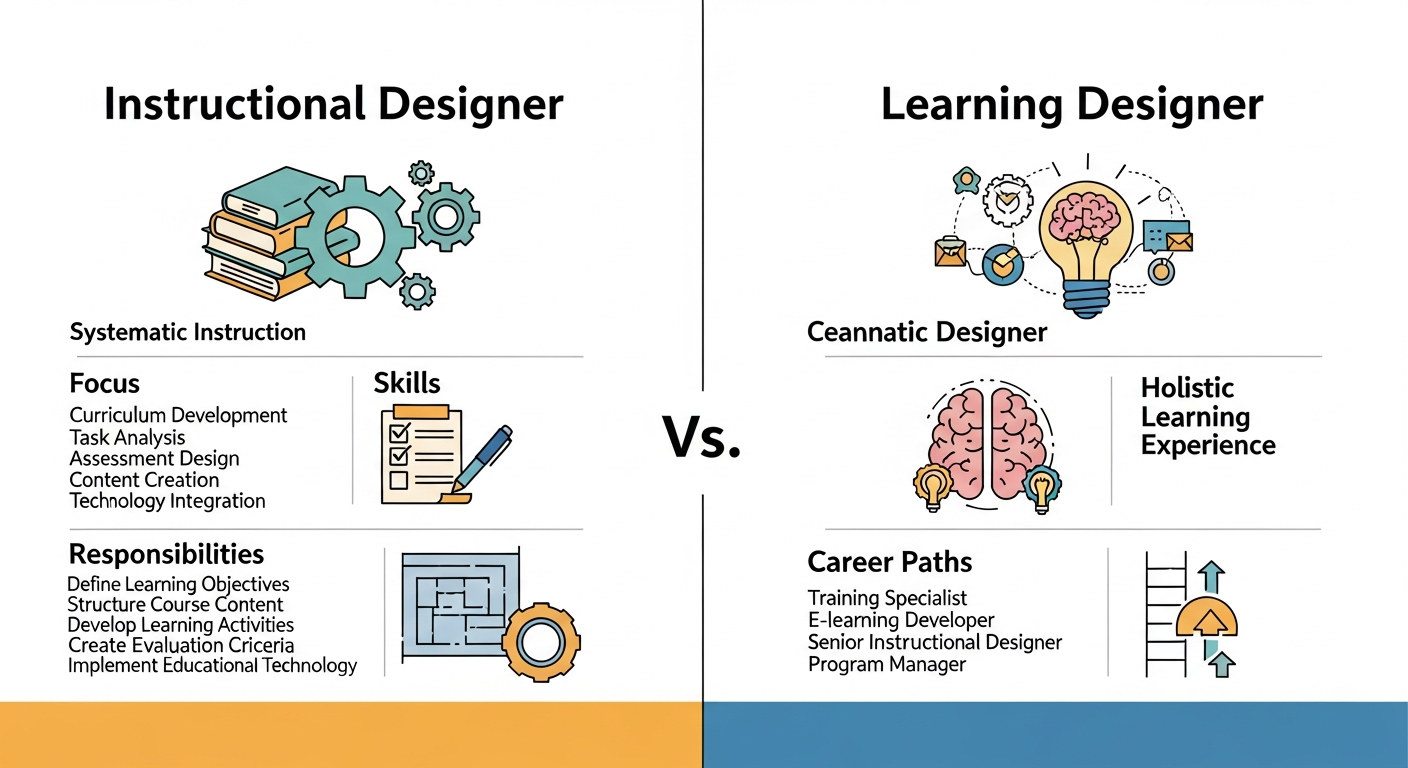
- IDs architect instruction quality; LDs orchestrate the overall experience and engagement.
- In corporate L&D, LD scope is rising with AI, data, and workflow learning; academia remains ID-centric.
- Both partner with SMEs; LDs often lead multi-modal delivery and stakeholder alignment.
- When unsure, hire for learning designer scope but validate ID depth in interviews.
What is the primary difference between instructional designer vs learning designer?
The core decision behind instructional designer vs learning designer is about fit-for-purpose impact. You’re balancing the need to create pedagogy-sound content (clear objectives, practice, feedback, and assessment) with the need to drive on-the-job performance (workflow integration, just-in-time resources, data-informed personalization).
According to recent industry trends, the distinction is becoming more pronounced as “learning experience” takes center stage. Gartner research highlights that 2026 HR priorities focus heavily on leader and manager effectiveness, which requires learning that doesn’t just “teach” but “integrates” into the flow of work. This shift favors the learning designer’s broader focus on the environment and performance support.
- Common pain points: Manual content builds, low engagement in compliance, slow SME reviews, scattered tools, and difficulty proving business outcomes.
- Decision hinge: If your risk is quality of instruction, prioritize ID depth. If it’s adoption and business alignment, prioritize LD breadth.
The ROI of instructional rigor vs learner experience
While the roles overlap, the Return on Investment (ROI) is measured differently. Instructional designers provide ROI through reduced errors and mastery of complex technical skills. In contrast, learning designers provide ROI through increased engagement rates and faster time-to-competency. A study by LinkedIn Learning found that “learning at the point of need” is the #1 priority for L&D professionals, reinforcing the rise of the learning designer role in agile corporate environments.
How did these roles evolve historically?
Instructional design emerged from formal education and military training models (e.g., ADDIE, Gagné’s Nine Events), emphasizing systematic analysis and assessment. This was a time when training was a “discrete event”—you left your desk to go to a classroom.
As digital learning matured in the workplace, the learning designer concept grew to include experience design, accessibility, analytics, and change management. This represents a shift from “course creation” to capability building across moments of need. When comparing instructional designer vs learning designer, we see the latter adopting methods from User Experience (UX) design to solve the “engagement crisis” in corporate training. You can explore more on these methodologies in our guide to ADDIE vs Agile in eLearning design.
See foundational overviews at ATD and research-led best practices on engagement from the Nielsen Norman Group.
Instructional designer vs learning designer: Quick comparison table
| Dimension | Instructional Designer (ID) | Learning Designer (LD) |
|---|---|---|
| Primary Focus | Objectives, content structure, practice, assessment validity | End-to-end learner experience, workflows, adoption, outcomes |
| Typical Methods | ADDIE, backward design, Gagné, Bloom’s Taxonomy | Design thinking, LX design, jobs-to-be-done, data-led personalization |
| Key Artifacts | Storyboards, scripts, item banks, mastery rubrics | Journey maps, modality mix, nudges, enablement assets |
| Core Tools | Authoring (SCORM/xAPI), quiz banks, accessibility checkers | LMS/LXP orchestration, analytics, automation, AI content ops |
| Where They Thrive | Academia, certification, regulated training | Corporate L&D, enablement, hybrid workforces |
What solution mix works best across corporate and academic environments?
In academia, instructional designer roles dominate due to accreditation, rubric-driven assessment, and term schedules. In corporate L&D, the learning designer scope is rising with AI tooling, skills data, and “learning in the flow of work.” Most organizations benefit from a blended model that pairs solid instructional methods with experience and data capabilities.
According to McKinsey’s State of Organizations report, the ability to build internal capabilities is a top priority for 2026. This requires a shift from “static courses” to “dynamic learning paths,” a transition where the learning designer’s skill set becomes the bridge between business strategy and educational execution.
Corporate vs academic focus in ID and LD roles
- Corporate: Cycle times are short, content changes frequently, and success is measured in time-to-competence, enablement KPIs, and compliance completion. Delivery spans microlearning, performance support, and manager-led practice. Benchmarks and practical guidance from ATD Research and The Learning Guild are helpful.
- Academic: Terms/semesters, summative grading, and peer review shape priorities. IDs partner closely with faculty on rubrics and course shells; LD elements show up in accessibility, UDL, and learner analytics.
Essential skills and tools for the modern L&D professional
The toolkit for an instructional designer vs learning designer is converging, but the application differs. Modern professionals must be fluent in AI-assisted content creation to keep pace with the 75% increase in demand for real-time training content seen in 2024.
- Instructional designer skills: task analysis, learning objectives, scenario writing, assessment design, SME interviewing, accessibility standards (WCAG), QA.
- Learning designer skills: learner research, journey mapping, change management, data storytelling, automation, AI promptcraft, enablement with managers.
- Common tools: authoring tools (SCORM/xAPI), LMS/LXP, video tools, analytics dashboards, collaborative review tools.
Modern teams increasingly add AI course generators to cut production time while maintaining quality controls. This is where CourslyAI provides a competitive edge by automating the heavy lifting of instructional architecture.
How does Smart Arena help each role deliver faster with quality?
Smart Arena pairs an AI-powered course creation engine (CourslyAI) with a modern enterprise LMS. When looking at the instructional designer vs learning designer dynamic, our platform bridges the gap by offering tools that support both precision and experience.
IDs get guardrails for objectives, practice, and quizzes; LDs orchestrate multi-modal journeys, nudges, and analytics—without heavy admin. For small L&D teams, this compresses time-to-launch from weeks to days while keeping instructional integrity. This is particularly important as SHRM reports that speed-to-productivity is now a key metric for HR success.
- For instructional designers: Generate first-draft storyboards, assessments, and feedback prompts; enforce accessibility checks; export SCORM/xAPI.
- For learning designers: Build role-based paths, automate reminders, embed microlearning in channels workers already use (like Slack or Teams), and track adoption with simple dashboards.
- For SMEs: Comment inline, approve quickly, and reuse content blocks.
The 2026 L&D Strategy: When to hire which role?
Choosing between an instructional designer vs learning designer depends on your current L&D maturity. If you are starting from scratch or building a complex certification program, the structural integrity of an ID is non-negotiable. If you are trying to scale engagement across a global, hybrid workforce, the experience-first approach of an LD is your best bet.
Hiring guide for L&D leaders
- Choose ID when accuracy, assessment validity, and compliance are paramount (e.g., regulated training, medical certification prep).
- Choose LD when speed, multi-modal experience, and business integration matter (e.g., sales enablement, operations, frontline training).
- Choose a hybrid when headcount is limited—evaluate portfolio samples for both pedagogical rigor and user-centric experience design.
Collaboration with SMEs and stakeholders
Both roles depend on SMEs. A practical split is: ID drives accuracy and practice; LD drives relevance and adoption. Use structured, time-boxed reviews, and capture tacit knowledge (screenshots, short video, system walkthroughs). Align early on must-know vs nice-to-know and define what “good” looks like with data (completion, attempts, help-desk tickets, performance KPIs). For a detailed look at how to structure your team’s tools, see how to build an L&D tech stack that scales.
How Smart Arena Stands Apart in the L&D Ecosystem
Competitor snapshot: Docebo positions toward AI-driven skills execution; iSpring leads with hands-on authoring; TalentLMS focuses on practical enablement for SMBs. These are strong ecosystems, but often require specialized roles to manage effectively.
Smart Arena differentiation:
- Unified Workflow: AI-powered course creation + enterprise LMS in one flow. This empowers a single learning designer to do the work of a three-person team.
- Human-centered, scalable learning: role-based paths, multilingual support, and mobile-first delivery for non-desk workers.
- Actionable Analytics: We tie course engagement to operational KPIs your leaders already track, helping you prove the ROI of your instructional designer vs learning designer investment.
What does an instructional designer do day to day in corporate L&D?
They analyze tasks, write learning objectives, design practice and feedback, script scenarios, build assessments, and QA content for accessibility and accuracy. They work closely with SMEs to ensure content is correct and measurable.
How is a learning designer different from an eLearning designer?
An eLearning designer often focuses on digital course production and visual design. A learning designer designs the entire learner journey across formats: microlearning, on-the-job checklists, coaching guides, and communications that drive adoption. For more on choosing the right platform for these journeys, see Smart Arena vs Moodle: Which fits small L&D teams?
Can AI replace instructional designers or learning designers?
AI accelerates drafts, variations, and QA, but it doesn’t replace human judgment on context, empathy, and ethical practice. Instead, AI allows designers to shift from “content creators” to “learning strategists.” To ensure you’re picking the right AI tools, check out our TOP AI authoring tools..
Which role should small L&D teams hire first?
Hire for learning designer breadth but test for instructional rigor. A hybrid can deliver end-to-end value—then add a specialized ID as compliance or certification needs grow.
Balancing Instructional Designer vs Learning Designer
If your top risk is instructional quality or audit readiness, lead with an instructional designer. If your challenge is adoption, speed, and integration with work, prioritize a learning designer. Ultimately, the modern L&D professional is a blend of both—someone who respects the science of learning while mastering the art of the experience.
Most teams benefit from a hybrid approach and the right platform support. Smart Arena’s CourslyAI and LMS help both roles launch faster, standardize quality, and connect learning to tangible business outcomes.