When Telekom needed to keep a large, fast-moving workforce trained on new products and processes, its learning team faced a familiar bottleneck: building courses took too long. By the time a training module was designed, reviewed, and published, the information inside it was already aging. After moving to an AI LMS, that same team began designing courses roughly five times faster — turning a multi-week production cycle into a matter of days, without adding headcount.
That shift is the whole story of why AI LMS platforms are reshaping corporate training. (See how Telekom and other teams did it.) So let’s answer the question directly.
What Is an AI LMS?
An AI LMS is a learning management system with artificial intelligence built into its core — used to create training content, personalize what each learner sees, and automate the administrative work that traditionally slows L&D teams down. A traditional LMS stores and delivers courses. An AI LMS helps you build those courses, tailor them to each employee, and run the program with far less manual effort.
Put simply: a conventional LMS is a digital filing cabinet for training. An AI LMS is a filing cabinet that also helps you write the files, recommends the right one to each person, and tells you which ones are working.
The distinction matters because “LMS with AI features” has become a crowded marketing claim. Most platforms have bolted a chatbot or a search tool onto an otherwise traditional system. A true AI LMS is different: artificial intelligence touches the three jobs that actually consume an L&D team’s time — content creation, personalization, and administration.
How an AI LMS Is Different From a Traditional LMS
For two decades, the corporate LMS has done one job well: host courses and track completions. Someone still had to create every course by hand — writing the content, designing the slides, building the quizzes, and uploading it all. That authoring work is where most training budgets and most training delays actually live.
An AI LMS changes the economics of that work. Instead of starting every course from a blank page, learning teams start from a prompt, a document, or an existing knowledge base, and the system drafts a structured course in minutes. The human expert then reviews, refines, and approves — staying in control of quality while skipping the slow mechanical parts.
The result isn’t just speed. It’s the ability to keep training current. When a process changes, an AI LMS lets you regenerate or update the affected course quickly, rather than treating every update as a fresh production project. For industries where products, regulations, and procedures change constantly, that responsiveness is the real prize.
What Artificial Intelligence Actually Does Inside an LMS
“AI” can mean almost anything in a product pitch, so it’s worth being concrete. In a corporate AI LMS, artificial intelligence shows up in a few specific, practical ways.
AI course authoring. This is the highest-impact capability and the one behind Telekom’s results. You give the system source material — a policy document, a product spec, a set of notes, or simply a topic — and it generates a complete course outline, lesson content, and assessment questions. Smart Arena’s built-in AI authoring tool, Coursly AI, does exactly this: it turns existing knowledge into structured, ready-to-edit courses, so subject-matter experts no longer need instructional-design skills or weeks of lead time to publish.
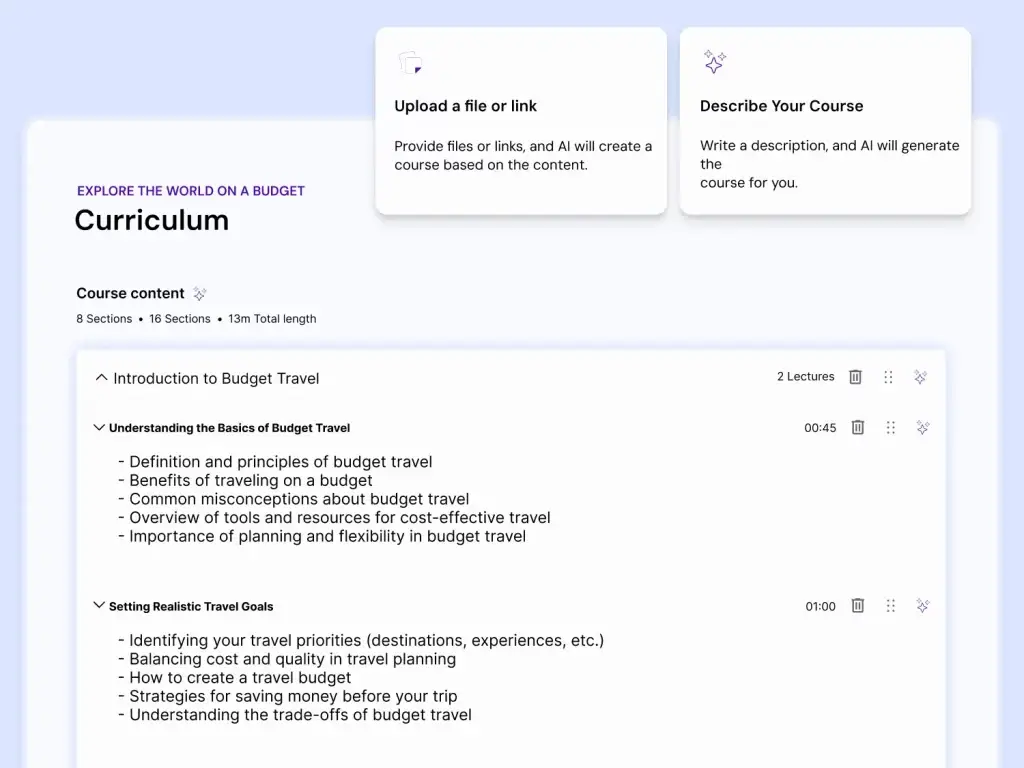
Automated assessment generation. Writing good quiz questions is tedious and easy to skip. An AI LMS can generate question banks directly from course content, varying formats and difficulty, so every module ships with a way to check understanding rather than just measuring clicks.
Personalized learning paths. Not every employee needs the same training in the same order. AI can recommend the next most relevant course based on someone’s role, performance, and progress — turning a one-size-fits-all catalog into a path that adapts to each learner.
Administrative automation. Enrollments, reminders, reporting, and recertification tracking are the invisible workload of running a training program. AI handles the routine parts — flagging who’s behind, nudging learners automatically, and surfacing the reports managers actually need — so a small team can run a large program.
Faster content updates and translation. When something changes, AI can help revise existing courses and adapt content into 70+ languages for different teams, which is especially valuable for companies operating across multiple regions.
The common thread: AI removes the manual, repetitive labor around training so that human expertise goes into judgment and quality, not data entry and slide formatting.
Why AI LMS Adoption Is Accelerating in Corporate Training
A few pressures are pushing companies toward AI-powered learning platforms at the same time.
The first is the pace of change. Products, tools, and compliance requirements shift faster than traditional course-production cycles can keep up with. If it takes six weeks to build a course about something that changes every quarter, your training is structurally out of date. AI authoring closes that gap.
The second is the size of most L&D teams. The majority of companies don’t have a large learning department — they have one or two people, or an HR generalist who owns training alongside everything else. Traditional authoring tools assume a dedicated instructional designer. An AI LMS is built for the reality of small teams that need to produce a lot of training without a lot of specialists.
The third is cost pressure. Enterprise learning platforms with advanced AI have historically been expensive and complex — priced and built for organizations with 500-plus employees and a budget to match. That left small and mid-sized companies choosing between bare-bones systems and tools they couldn’t afford or staff. The arrival of AI-native platforms at accessible price points is what’s opening this technology up to the broader market.
The Telekom Case Study: 5x Faster Course Design
It’s worth returning to the example we opened with, because it shows what these capabilities add up to in practice.
Telekom’s learning team needed to produce a high volume of training and keep it current across a large workforce. Their constraint wasn’t strategy or subject expertise — it was production throughput. Every course required someone to manually structure the content, write the material, and build the assessments before it could reach a single learner.
After adopting an AI LMS with built-in authoring, the team began designing courses roughly five times faster. The AI drafted course structure and content from their existing material; their experts reviewed and refined rather than building from scratch. The same team, with the same expertise, simply spent its time differently — on quality and judgment instead of mechanical production.
The lesson for any training leader: the bottleneck in corporate learning is rarely a shortage of knowledge. It’s the time it takes to turn that knowledge into a finished course. An AI LMS attacks exactly that bottleneck.
What to Look For in an AI LMS
If you’re evaluating AI LMS systems, the marketing claims will blur together quickly. A few questions cut through the noise.
Is the AI native, or bolted on? Ask whether AI authoring is core to the platform or an add-on module — often a separate, premium product. Native authoring tends to be simpler to use and included rather than upsold.
Can a non-designer create a quality course? The whole point of an AI LMS is to make professional course creation accessible to subject-matter experts who aren’t instructional designers. If the tool still assumes design expertise, it hasn’t solved the real problem.
Does it fit your team’s size and budget? Some of the most capable AI learning platforms are priced for large enterprises. If you’re a small or mid-sized company, look for a platform built for your scale — one that doesn’t require a dedicated L&D admin to operate.
Is there proof it works at speed? Capability claims are easy. Ask for concrete results — like Telekom’s 5x faster course design — that show the platform delivers throughput, not just features.
Does it cover the full cycle? Authoring, delivery, personalization, assessment, and reporting should live in one system. Stitching together separate tools recreates the complexity an AI LMS is supposed to remove.
How an AI LMS Fits Into Your Existing Training Program
A common worry is that adopting an AI LMS means tearing out everything you’ve already built. It doesn’t. The strongest case for an AI-powered platform is continuity: your existing courses, documents, and knowledge become the raw material the AI works from, rather than content you throw away.
In practice, most teams start in one of three places. Some begin with net-new training — a product launch or a compliance requirement that needs courses fast, where AI authoring proves its value immediately. Others start by modernizing stale content, feeding outdated slide decks and documents into the system to regenerate them as current, structured training. And some lead with onboarding, where the volume of repeatable training is highest and the time savings compound with every new hire.
Whichever entry point you choose, the goal is the same: shorten the distance between “we know something employees need to learn” and “the course is live.” That distance — not strategy, not budget alone — is what an AI LMS is designed to collapse.
Frequently Asked Questions About AI LMS Systems
What does AI LMS stand for?
AI LMS stands for artificial intelligence learning management system — a training platform that uses AI to create content, personalize learning, and automate administration, rather than only storing and delivering courses.
Is an AI LMS only for large enterprises?
No. While early AI learning tools were priced for large organizations, AI-native platforms like Smart Arena are built for small and mid-sized corporate training teams, including teams of one or two people without dedicated instructional designers.
Does an AI LMS replace instructional designers?
No — it changes what they spend time on. The AI handles the mechanical work of structuring and drafting courses; human experts focus on accuracy, quality, and strategy. Teams without designers can produce professional training they couldn’t have managed before.
Can an AI LMS create courses from my own content?
Yes. A capable AI LMS generates structured courses from your existing material — documents, product specs, policies, or notes — so your institutional knowledge becomes training without manual rebuilding.
The Bottom Line
An AI LMS isn’t a traditional learning management system with a chatbot attached. It’s a rethinking of where human effort goes in corporate training — moving people away from the slow mechanical work of building courses and toward the judgment that actually makes training good. Artificial intelligence handles authoring, personalization, and administration; your experts handle quality and strategy.
For training leaders, the practical takeaway is the one Telekom demonstrated: when you remove the production bottleneck, you can keep training current, cover more topics, and do it with the team you already have. That’s why AI is changing corporate training — and why the LMS category is being rebuilt around it.
Smart Arena is built for exactly this shift: an AI LMS with Coursly AI authoring at the core, designed for corporate training teams that want enterprise-grade capability without enterprise cost or complexity. See how fast your team could be building courses — book a demo or start a free 14-day trial (no credit card required).