Your employees are clicking through compliance modules as fast as humanly possible. Your audit logs look clean. Your knowledge gaps are getting worse. Here’s how to fix the problem at the root — without rebuilding your entire L&D program from scratch.
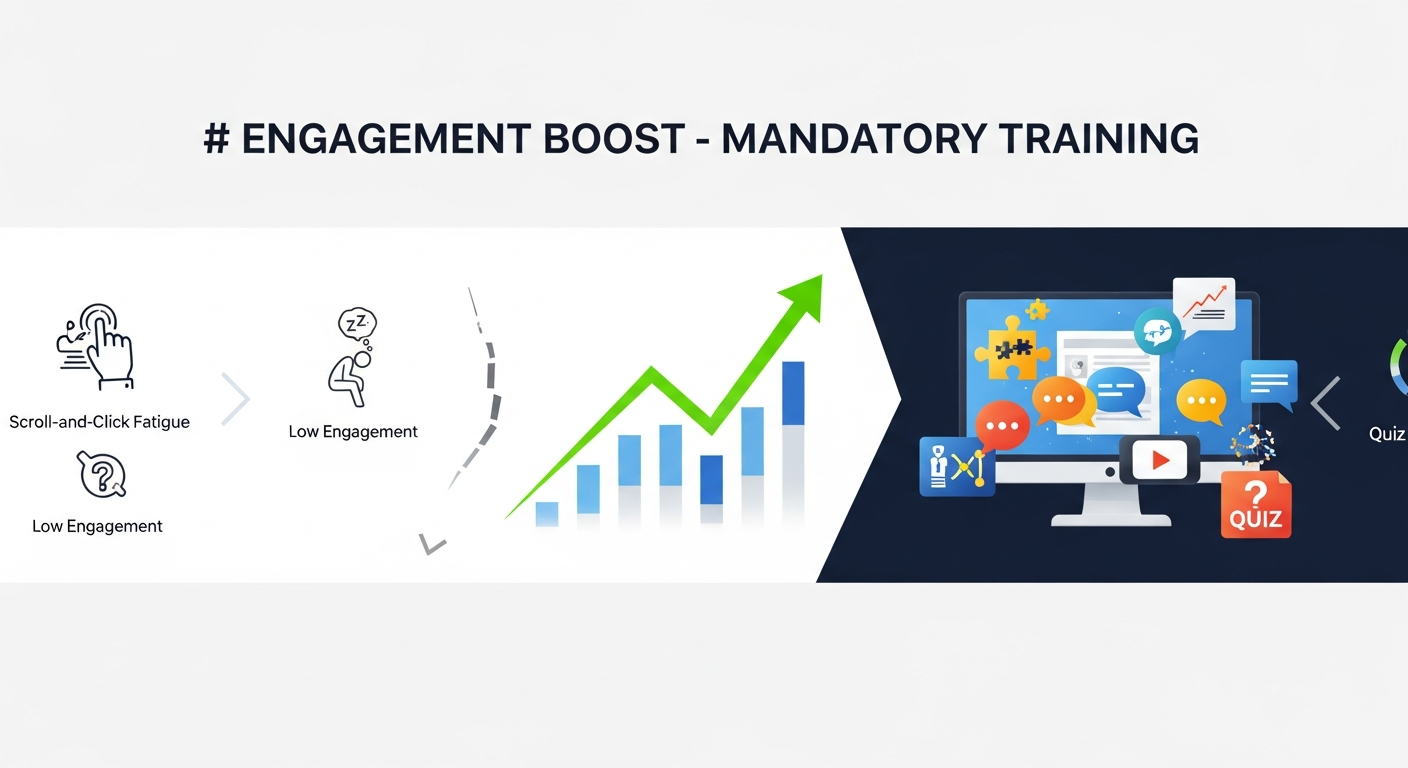
Why Mandatory Training Has a Completion Problem and a Retention Problem
Completing a course and learning from it are two very different things. Most enterprise HR teams know this, but the pressure to show completion rates — for auditors, for the board, for compliance deadlines — means the second problem often goes unaddressed.
The numbers are sobering. Research on the Ebbinghaus forgetting curve shows that without active reinforcement, employees forget up to 70% of new information within 24 hours of a training session. For compliance-heavy industries like healthcare, manufacturing, and financial services, that’s not just an L&D issue — it’s a risk management issue. And yet the default response is still the same: longer modules, more slides, and an automated reminder email three days before the deadline. Gartner research finds that only 20% of employees actually apply what they learn in training to their jobs — largely because the content isn’t connected to their specific role, risk profile, or daily reality.
The core tension: Mandatory training exists to reduce organizational risk. But when it’s designed for checkbox compliance rather than genuine behavior change, it creates the illusion of safety while leaving actual knowledge gaps untouched. For multi-site enterprises running training across hundreds or thousands of employees, the gap between “completed” and “understood” is where incidents happen.
The Cognitive Science Behind Why Traditional Compliance Modules Fail
The problem with most compliance e-learning isn’t the content. It’s the delivery model. Long, linear modules force employees into a passive state that neuroscience tells us is almost designed for forgetting.
Three structural issues drive most of the disengagement enterprise HR teams report:
- Cognitive overload from monolithic sessions. A 60-minute compliance module covering fire safety, data privacy, and workplace harassment in one sitting exceeds what working memory can handle. The brain doesn’t consolidate information under pressure — it skims and discards.
- “Click-fatigue” from low interactivity. The infamous “click next to continue” design teaches employees one thing: find the fastest route to the end. When there’s no meaningful decision to make, the brain disengages within minutes. This is “superficial completion” — and it’s what most LMS completion reports are actually measuring.
- One-size-fits-all content that ignores role and risk. A forklift operator and a finance analyst don’t share the same risk profile. Presenting the same safety module to both doesn’t just waste time — it signals to both that the training wasn’t designed with them in mind, which immediately undermines credibility and relevance.
This is compounded for multi-location enterprises managing workforces across different sites, languages, and regulatory environments. When your L&D team in Ljubljana is responsible for training compliance for warehouse staff in Zagreb and office workers in Belgrade, a single static module isn’t a training strategy — it’s a liability.
Interactive Learning Content: What It Actually Means in a Compliance Context
“Interactive” is one of the most overused words in the LMS market. Adding a drag-and-drop activity to a compliance slide deck isn’t interaction — it’s decoration. Real interactivity means the learner has to make a decision, feel the consequence, and understand why.
These five interaction patterns consistently outperform passive delivery in compliance contexts:
1. Branching Decision Scenarios
Place employees in a realistic situation they might actually face: a suspicious email arriving in their inbox, a safety shortcut being taken on the floor, a data request that doesn’t feel right. The path they choose determines what happens next. Score by risk level, not just correctness — this shows the real-world weight of each decision rather than treating every answer as equally right or wrong.
2. Micro-Scenarios (60–90 Seconds)
Short video vignettes or illustrated scenarios followed by one or two critical decisions. These work especially well for shift workers, factory floor staff, and clinical teams who have limited time and inconsistent access to devices. They can complete a meaningful learning interaction in the time it takes to drink a coffee.
Read more about microlearning.
3. Confidence-Based Assessment
Instead of a standard multiple-choice question, ask: “How certain are you of your answer?” This surfaces “unconscious incompetence” — employees who selected the correct answer by elimination but couldn’t explain why. It enables far more targeted remediation than pass/fail scoring alone, and gives HR teams genuinely useful data about where knowledge gaps actually exist versus where people just got lucky.
4. Interactive SOPs and Checklists
Convert Standard Operating Procedures into step-by-step interactive trackers with just-in-time guidance and embedded media. Instead of a PDF that nobody reads, employees work through a live tool that functions as both training and job aid. Completion becomes meaningful because it mirrors actual task performance.
5. Spaced Reinforcement
Rather than treating training as a single event, break content into shorter modules delivered over time. A 2-minute knowledge booster at day 7 and day 30 directly combats the forgetting curve. This approach doesn’t require a specialist tool — it requires a platform that lets L&D teams structure content delivery across a defined timeline and trigger follow-up modules automatically based on completion or time elapsed.
Why Shorter, Focused Modules Outperform 60-Minute Compliance Slogs
The human brain isn’t built for hour-long compliance lectures. It’s built for short, meaningful interactions spaced over time. Nielsen Norman Group research confirms that focused, shorter learning formats are significantly more effective for mobile users and professionals with fragmented attention — which describes most of the people sitting through your mandatory training.
Breaking a 60-minute compliance course into a series of shorter, focused modules does several things at once:
- Reduces the barrier to starting — a short, focused module feels manageable; a 60-minute block triggers procrastination
- Forces content discipline — each module must cover one objective, one scenario, one check, which eliminates padding
- Enables mobile completion — critical for workforces in logistics, manufacturing, retail, and healthcare who aren’t desk-based
- Creates natural reinforcement windows — follow-up modules at day 7 and day 30 directly address the forgetting curve without requiring employees to sit through the full course again
What good looks like in practice: A major insurer in the Adriatic region uses Smart Arena to deliver training to thousands of geographically dispersed employees and partners. Rather than running large, infrequent sessions, they deliver knowledge in short, digestible formats — what their team describes as “knowledge nibbles” that employees can complete in minutes during their workday. The result is a learning experience that fits around real work schedules without competing with them.
Multilingual Training Across Multi-Site Workforces: Where Most LMS Platforms Quietly Fail
For enterprise HR teams managing multi-site, multilingual workforces, accessibility is where most LMS platforms quietly break down. A well-designed compliance module is worthless if it’s only available in one language, or if it requires a desktop login that your field team can’t access during a shift.
Practical accessibility for distributed and shift-based workforces requires:
- Genuine multilingual support — not just translated text, but an interface and content structure that works natively across languages. For HR directors managing compliance across the Adriatic region — where workforces frequently span Slovenian, Croatian, and Serbian speakers — this isn’t a nice-to-have. It’s a prerequisite.
- Mobile-first design that actually works on a phone, not a desktop layout that has been squeezed into a smaller screen. Employees completing training on a mobile device during a break need tap targets that work, content that loads quickly, and a login process that doesn’t require five steps.
- Flexible content formats — video, document, quiz, and interactive content — that can be consumed in whatever sequence and timeframe suits the learner’s work pattern, not a fixed session schedule.
Smart Arena supports 10 interface languages with content creation in any language, and is fully responsive across mobile, tablet, and desktop. For multi-site enterprises in the Adriatic region, this means a single platform can serve your entire workforce without requiring separate localised deployments.
Moving Beyond Completion Rates: The Metrics That Actually Prove Compliance Training Works
Completion rate is the metric that satisfies auditors. It’s not the metric that proves your training program is working. For L&D and HR directors who need to make the case to a CHRO or board, you need a data layer that goes deeper.
The metrics that tell the real story:
- Assessment scores and pass rates by role and location: A company-wide 80% pass rate can hide a site or department sitting at 40%. Segmented data is what surfaces those pockets of risk.
- Time-to-completion trends: Are employees completing training faster or slower over time? A sharp drop in time-to-completion without a corresponding drop in pass rate often signals “click-through” behaviour rather than genuine engagement.
- Certificate validity and renewal tracking: Which certifications are approaching expiry, and for which employees? Automated alerts before expiry prevent compliance gaps from emerging silently.
- Remediation rates: How often are employees flagged for retraining, and is that rate declining? A falling remediation rate over time is one of the clearest signals that knowledge is actually transferring, not just being certified.
- Training ROI against operational outcomes: Where it’s possible to link training data to operational incident data, this becomes the most powerful argument available. A measurable reduction in workplace incidents or compliance findings following a training redesign is a board-level conversation.
What good reporting looks like: An HR director at a multi-site manufacturer should be able to open a dashboard and see, in real time, which of her sites has the lowest pass rate on the current COSHH module — and push a targeted follow-up module to those specific employees before the next audit window. That’s compliance management. Completion rate reports are compliance documentation. The difference matters when something goes wrong.
How to Evaluate LMS Platforms for Mandatory Training: What Enterprise HR Should Actually Be Asking
When you’re comparing Smart Arena against Moodle, Cornerstone, Docebo, TalentLMS, or SuccessFactors for a mandatory training deployment, the vendor conversation tends to focus on features. The more useful conversation focuses on your actual operational constraints.
Questions that cut through the sales deck:
- Can the system assign different training paths automatically based on role, site, and group — without manual rule-building for every new hire or role change?
- What does the analytics layer actually show? Can a site manager see their team’s completion status and scores without logging an IT ticket or waiting for a monthly report?
- How does the platform handle employees who don’t have consistent device access or who work across shifts? Is mobile access genuinely usable, or just technically available?
- What’s the real implementation timeline — and what does “implemented” mean? A platform where employees can log in is not the same as a platform where compliance training is running, tracked, and reportable.
- Does the system integrate with your existing HRIS — or does compliance tracking live in a separate silo that someone has to reconcile manually each month?
- What happens when regulations change? Can content be updated centrally and reassigned automatically to affected user groups, or does the L&D team have to rebuild and reassign manually?
If a vendor can’t answer these questions specifically and confidently, that tells you something important about what post-sales support will look like.
How Smart Arena Supports Mandatory Training for Enterprise HR
Smart Arena is built for the compliance training challenges that enterprise HR teams in healthcare, manufacturing, logistics, financial services, and public administration deal with at scale. Here is what the platform actually delivers — and where it adds the most value for mandatory training programmes.
- AI-powered course creation with CourslyAI: Convert existing policy PDFs, PowerPoint presentations, and Word documents into structured e-learning courses in minutes. CourslyAI generates course content, knowledge checks with 10+ question types, and translates content into 70 languages — significantly reducing the time your L&D team spends on content development and localisation. These are TOP SCORM authoring tools.
Read how AI could transform L&D. - Automated enrollment and workflow logic: Set rules once and let the system handle the rest. Automatically enroll employees in mandatory training based on role, location, or group. Trigger re-enrollment when a certificate expires. Send automated reminders before deadlines. Build conditional workflows such as enrolling new hires in onboarding compliance on day one without any manual intervention.
- Role-based learning paths and compliance programmes: Structure mandatory training as multi-course programmes with sequential progression, prerequisites, and minimum completion thresholds. Assign different paths to different user groups — your forklift operators and office staff can follow separate compliance tracks within the same platform, managed from a single admin view.
- Blended learning — e-learning and instructor-led in one place: Schedule and manage instructor-led training sessions alongside digital courses, with attendance tracking, feedback collection, and automated records. For compliance programmes that require in-person sign-off alongside digital completion, this removes the need to manage two separate systems.
- 10-language interface with content in any language: The platform interface supports 10 languages natively, and CourslyAI can translate course content at the click of a button. For multi-site enterprises across Slovenia, Croatia, Serbia, and wider international operations, this means one platform that your entire workforce can use without localisation projects.
- Real-time compliance reporting and audit-ready exports: Track completion, assessment scores, attendance, and certification status in real time by learner, team, site, or course. Managers receive automated weekly email reports on their team’s training status. Export audit-ready reports with digital signature support in one click — no manual compilation before an inspection.
- HRIS integration and SSO: Sync user data with your HRIS system — Workday, SAP, BambooHR, or your regional HR platform — via the Smart Arena API or direct integration. SSO login means employees access training through their existing organisational credentials, removing friction and improving adoption rates.
What our customers say: Sava Insurance uses Smart Arena to deliver training to thousands of geographically dispersed employees and market network partners across Slovenia and Croatia. Smart Arena has simplified the management of our e-learning. It connects to our HR system and generates great reports showing who completed what and when.
The Bottom Line: Compliance Training That Works Is Designed to Be Used
The goal of mandatory training isn’t a 100% completion rate. It’s a workforce that makes better decisions under pressure — in the moment when a data request looks slightly off, a safety shortcut seems convenient, or a process step gets skipped because the shift is running late.
Getting there doesn’t require a complete L&D overhaul. Start with one high-risk module. Break it into shorter, focused segments. Assign it automatically to the right groups. Track what actually happened — not just who clicked through. Measure pass rates and score trends, not just completion. Then make the case for the next module with data.
The organisations that get this right aren’t the ones with the biggest L&D budgets. They’re the ones with the right infrastructure and the discipline to use it consistently.
Ready to see what this looks like for your organisation? Book a demo with Smart Arena and we’ll walk you through how other enterprise HR teams in healthcare, manufacturing, and financial services are managing compliance training at scale — using your own use case as the starting point.
FAQs: Mandatory Training Engagement for Enterprise HR
How do I improve compliance training completion rates across multiple sites without increasing admin time?
The most reliable approach is automated, role-based assignment combined with time-boxed team challenges. When completion becomes a site-level team goal rather than an individual burden, peer motivation drives completion without constant HR chasing. Pair this with automated reminders triggered by completion SLA windows — not manual calendar-based nudges — and your admin workload drops significantly. The key is an LMS that handles assignment, reminders, and escalation logic automatically based on the rules you set once.
What’s the best way to make GDPR, fire safety, or harassment training more engaging for employees who’ve seen it every year?
Change the format, not just the content. Employees who’ve completed the same linear module for three consecutive years have learned to autopilot through it. Replacing the module with branching decision scenarios — where they face realistic situations and have to choose a course of action — breaks that autopilot even if the underlying policy hasn’t changed. The scenario creates engagement; the decision creates learning. AI authoring tools like CourslyAI make it significantly faster to rebuild existing compliance content into this format without starting from scratch.
How can I deliver mandatory training to employees who work across shifts or don’t have consistent device access?
A mobile-responsive platform is the minimum requirement — but it matters whether that means genuinely usable on a phone, not just technically accessible. Employees completing training between shifts need a fast login, clear navigation, and content that works on a mobile screen without zooming and scrolling. Shorter modules are also critical here: a 5-minute focused module is realistic for a shift worker; a 45-minute session is not.
How do I demonstrate the ROI of our compliance training program to the board or CHRO?
Move the conversation from completion rates to outcome metrics. Present assessment score trends before and after a training redesign. Show time-to-compliance improvements by site. Where incident or audit data is available, correlate training improvements with operational findings. SHRM research shows that companies with structured training programs see 24% higher profit margins — the business case exists, but it requires a reporting layer that goes beyond headcount completion figures.
Can we personalise mandatory training content by role and risk level without building a separate course for every job function?
Yes — this is what role-based learning paths and smart assignment rules make possible. A single policy framework can feed different training paths for different user groups: high-risk roles receive more frequent or more detailed coverage; lower-risk roles receive a streamlined version. With an AI authoring tool, you can also generate role-specific content variations from the same source document without rebuilding each course manually.
How long does it realistically take to implement a new LMS for compliance training across a 1,000+ employee organisation?
With a modern platform, a phased implementation can have your first compliance module live within two weeks for a pilot group. Full enterprise rollout across multiple sites typically takes 6–12 weeks depending on HRIS integration complexity, content migration volume, and how much existing material needs to be converted or rebuilt. Ask vendors for their median time-to-launch across customers of your size — not the minimum, which reflects ideal conditions rather than typical ones.