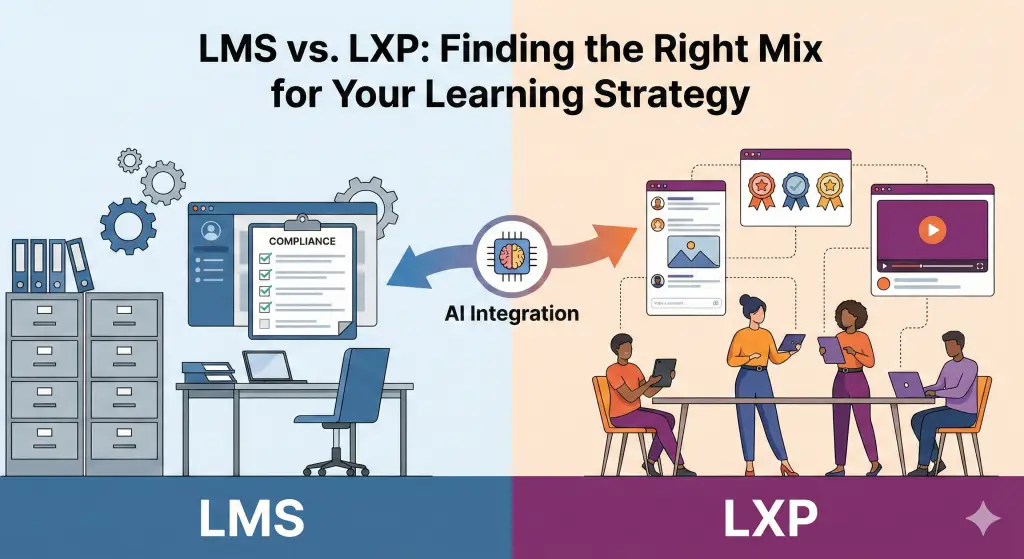
LMSs centralize and govern training (compliance, reporting, scale). LXPs personalize and engage learners (discovery, social, skills). Most growing enterprises need both — and AI now makes an integrated LMS + LXP approach practical by unifying data, content, and experiences. This guide helps you choose the right mix for your learning strategy.
The “status quo” of corporate learning is struggling. Research from Corporate Compliance Insights shows that 49% of employees admit to “skip-reading” or skimming mandatory training. For a growing enterprise, this isn’t just an engagement problem—it’s a massive compliance risk.
What problem are growing corporate learning teams trying to solve with LXP vs LMS?
As learning programs expand across locations and roles, teams face three persistent challenges: governance, engagement, and speed. An LMS (Learning Management System) excels at governance — managing enrollments, certifications, compliance, and audit-ready reporting across a distributed workforce. An LXP (Learning Experience Platform) excels at engagement — surfacing relevant content, enabling social learning, and personalizing experiences by skill, role, and interest. The core problem is balancing the rigor of compliance with the pull of learner-centric discovery — without fragmenting systems or multiplying admin work.
According to the LinkedIn Learning 2025 Workplace Learning Report, employees are 4x more likely to engage with training when it includes personalized recommendations. The core problem for L&D is balancing the rigor of compliance with the “pull” of learner discovery without multiplying the admin workload.
Signals you’ve outgrown a single-track approach:
- Compliance and audits strain manual processes (“Excel-based tracking,” scattered intranets, inconsistent evidence)
- Low engagement in mandatory training; limited personalization; little learning-in-the-flow
- Multi-language, multi-site reporting is slow; ROI stories are anecdotal
- Content creation can’t keep up with demand; SMEs need faster, AI-assisted authoring
This is why many enterprises compare LXP vs LMS for corporate learning — and increasingly combine them.
How do LXP and LMS differ for enterprise needs?
Use the table below to align platform capabilities to your goals. Then choose the primary system of record and extend with the complementary capability.
| Dimension | LMS | LXP |
|---|---|---|
| Primary purpose | Manage, deliver, and track training with compliance rigor | Personalize discovery, recommend content, boost engagement |
| Typical use cases | Onboarding, compliance, certifications, audit-ready reporting | Upskilling, career paths, social learning, in-the-flow microlearning |
| Data & reporting | Completion, attempts, scores, evidence/attestations | Engagement, skills signals, content relevance, search trends |
| Governance | Strong: roles, catalogs, curricula, approvals, audits | Flexible: user-driven curation, playlists, communities |
| Personalization | Rules-based paths, assignments by org/role | AI recommendations by skill, interest, behavior |
| Content | SCORM/xAPI compliance, formal courses | Formal + informal: articles, videos, UGC, external links |
| When to lead with it | Regulated industries, multi-site compliance, complex orgs | Skills transformation, leadership development, knowledge sharing |
Independent industry guidance notes this divide: LXPs emphasize experience and discovery while LMSs emphasize administration and compliance (Gartner; Fosway 9-Grid). For enterprise HR and L&D leaders, the question isn’t “either/or,” but “what leads and what complements?”
Beyond just tracking, learn more about how HR leaders are using automation to slash admin workloads across their entire training catalog.
When should an enterprise choose LMS, LXP, or both to scale, personalize, and engage?
Choose an LMS-first approach when:
- You must automate certifications, reminders, and compliance proof across sites
- You need structured curricula with formal assessments and proctored exams
- You require deep HRIS integration (e.g., SAP, Workday) and role-based assignments
Add LXP capabilities when:
- Upskilling and mobility matter: employees need personalized, skills-based paths
- Engagement is lagging in mandatory training; you want user-led discovery and social features
- Your content footprint is diverse (internal + external content, SME videos, articles)
Adopt an integrated LMS + LXP model if:
- You want audit-ready rigor and modern learning experiences in one unified environment
- You plan to scale globally (multilingual delivery, mobile, online/offline) while keeping local nuance
- You need executive-ready dashboards combining compliance, engagement, and skills signals
How does AI bridge LMS + LXP to create a modern learning experience?
AI now connects LMS governance with LXP-like personalization — without the overhead of separate tools. Here’s how:
- AI personalization: Recommends content by role, skill gaps, and behavior — driving a modern learning experience while honoring mandatory assignments (AI personalization and learning experience platform (LXP) signals).
- Skills graph: Maps content to competencies; suggests next-best learning for development plans.
- AI-powered authoring: Convert PDFs/Docs/Slides into interactive microlearning with knowledge checks in minutes — accelerating content supply for fast-growing teams. CourslyAI vs Articulate
- Unified search: Surfaces internal formal courses (LMS) and curated resources (LXP) in one place.
- Adaptive compliance: Shortens refresher training for proven experts; offers remediation for at-risk learners.
- Analytics: Combines compliance completion with engagement, time-to-competence, and skills progress to show impact.
Key takeaways for teams:
- Use the LMS as your source of truth for assignments, records, and audits
- Apply LXP-style AI recommendations to increase relevance and participation
- Streamline creation with AI so SMEs and trainers keep pace with business change
Real-World Success: Cinkarna Celje’s Digital Transformation
Theory is one thing; results are another. Cinkarna Celje, a chemical manufacturer with over 500 employees, faced the challenge of scaling safety training in a high-stakes environment. In an industry where the average cost of non-compliance is $14.8 million, the stakes were high. By moving away from manual, paper-based processes to an integrated LMS + LXP model with Smart Arena, they achieved:
- 40% faster onboarding for new hires.
- 60% reduction in administrative overhead via automated tracking.
- 50% increase in employee engagement by converting static directives into interactive content.
“We can take existing materials, such as organizational directives and regulations, and turn them into content users actually enjoy.” — Mateja Avberšek, HR at Cinkarna Celje.
What does an integrated approach look like with Smart Arena?
Smart Arena unifies an enterprise-grade LMS with an interactive training platform and an AI layer (CourslyAI) to deliver the best of both worlds:
- Governance-first: Certifications, audit trails, evidence capture, automated reminders, multi-language support
- Engagement & discovery: AI recommendations, playlists, microlearning, mobile-first UX, social features
- AI authoring (CourslyAI): Rapidly turn SOPs, policies, and slide decks into interactive courses
- Enterprise integrations: HRIS (e.g., SAP/Workday), SSO, content libraries, and data exports
- Insights: Dashboards for compliance, engagement, and skills development in one view
What is the key difference between an LXP and an LMS for corporate learning?
An LMS manages structured learning at scale — assignments, certifications, and compliance reporting. An LXP personalizes discovery and engagement through recommendations, skills, and social features. Most enterprises pair them so formal training and continuous learning coexist.
When should an enterprise adopt an LXP vs enhance the LMS with AI?
Adopt LXP capabilities when engagement and skills mobility are priorities. If your LMS supports AI recommendations, unified search, and skills mapping, you can achieve many LXP outcomes without adding a separate system.
How do we prove ROI of a modern learning experience?
Combine LMS metrics (completion, time-to-certify, audit findings) with LXP signals (engagement, skills progress, time-to-competence). Dashboards and cohort comparisons show impact on compliance risk, productivity, and retention.