We polled ~70 HR leaders at our latest event, and the signal was unmistakable. AI in HR is no longer a pilot project — it is now the operating layer of how teams approach learning and development. But the same data exposed a bottleneck that no AI tool can fix on its own.
TL;DR
- AI is here. 73% of HR leaders are already using AI tools for employee training.
- Hybrid wins. Live workshops and online platforms are essentially tied as preferred learning formats.
- Time is the killer. 64% of HR leaders name lack of employee time as the #1 barrier to development — not budget, not ROI.
The AI Adoption Curve in HR Is Already Past Tipping Point
We asked HR leaders how their organisations are positioned on AI tools for HR. The result was decisive:
- 73% are actively using AI tools.
- 17% are evaluating use cases.
- Only 3% consider AI not a priority.
This tracks with global benchmarks. The 2025 LinkedIn Workplace Learning Report shows 71% of L&D professionals are experimenting with AI training workflows [1]. McKinsey’s 2025 Global Survey on AI puts overall adoption at 88% [2]. The use cases are concrete: AI accelerates content authoring, personalises e-learning at the individual level, and identifies skill gaps that managers used to miss. SHRM reports that 41% of AI-using organisations rate their learning and development programmes as more effective than before [3].
Our take: If AI is not yet in your HR stack, you are already operating on yesterday’s productivity curve. The advantage compounds quickly.
How Companies Are Actually Training Employees
We asked how teams are running employee training in companies today. The split was tight:
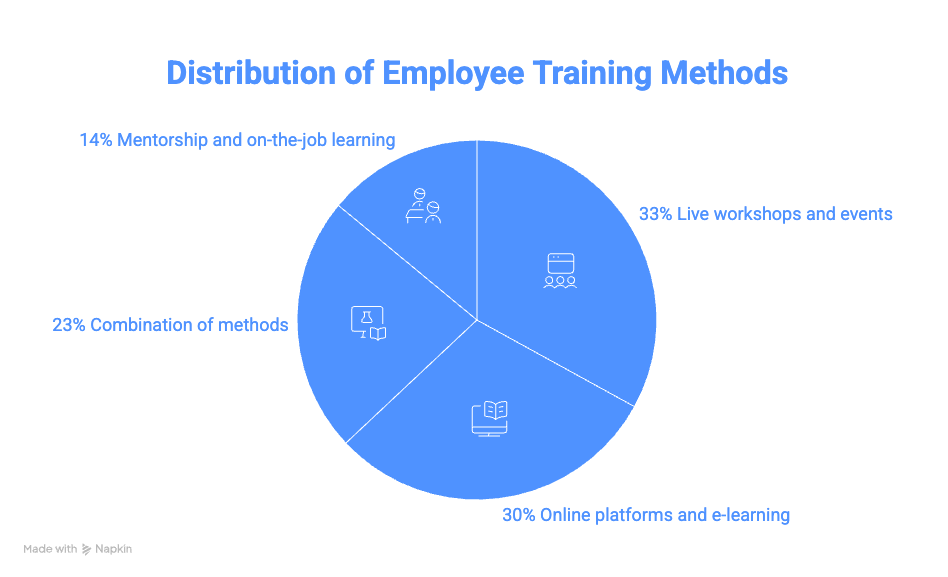
Live events and e-learning are running neck and neck. Digital tools carry the scale, but the human element — peer learning, facilitated discussion, real cases — is still where the highest-stakes development happens. Deloitte’s 2026 Global Human Capital Trends report frames this as “learning in the flow of work” [4]. The companies pulling ahead are not choosing between formats. They are stitching AI-driven microlearning into traditional formats, not replacing them.
The Real Bottleneck Is Not Technology. It Is Time.
The most decisive finding in our data was this: 64% of HR leaders identify “lack of employee time” as their single biggest obstacle to development.
For comparison:
- Budget constraints: 13%
- Proving ROI of training: 11%
- Speed of change: 11%
This is not local noise. The LinkedIn Workplace Learning Report calls “time and capacity” the primary barrier to career development globally, with 50% of managers and 45% of employees saying they lack the time or support to learn [1].
Our take: Organisations are in a paradox. They know employee development is the only durable response to AI-driven change, but their people are too busy executing yesterday’s work to engage with it. The tools are ready. The bandwidth is not.
Three Strategies to Unblock Growth in L&D
So how do you actually deploy AI in HR without burning out your teams? Three patterns are working in the organisations we work with.
1. Embed Learning in the Workflow
Stop running learning as a separate event. Use AI to push microlearning content directly into the tools employees already use — CRM, helpdesk, code editor, project board. Three-minute interventions inside the workflow consistently outperform 60-minute scheduled sessions. The “course” is no longer the unit. The moment of need is.
2. Leadership Has to Create the Time
This is not an HR problem. It is a leadership problem. If managers do not actively protect time for employee development, no platform — AI-powered or otherwise — will rescue the programme. Make development a quarterly business objective with its own metrics, not a line item on the HR budget.
3. Go Skills-First, Not Course-First
Mercer’s 2025 HR Trends report emphasises the shift to skills-based talent practices [5]. Define the 5–10 high-impact skills that move your business outcomes, then build corporate training around those skills only. Every minute spent learning should map to a skill the business has named as critical. This makes ROI defensible and time spent justifiable.
What Comes Next
The data is unambiguous: AI in HR is powerful, but it is wasted if your people cannot find the time to engage with it. The organisations that turn L&D into a real growth engine in 2026 will be the ones that tackle the time crunch first, then layer AI on top — not the other way around.
Ready to make your L&D infrastructure AI-ready?
Smart Arena is the EU-hosted, GDPR-aligned platform that runs the secure environments behind your HR and learning stack — Dev, Staging, and Production isolated, 99.9% SLA on the PREMIUM tier, 4-hour RPO on snapshots, and 8–12 week onboarding sprints.
If you are scaling AI tools for HR and need the infrastructure to keep employee data inside the EU, talk to our team.
References
[1] LinkedIn Learning. (2025). Workplace Learning Report 2025. https://learning.linkedin.com/resources/workplace-learning-report
[2] McKinsey & Company. (2025). The State of AI: Global Survey 2025. https://www.mckinsey.com/capabilities/quantumblack/our-insights/the-state-of-ai
[3] SHRM. (2025). The Role of AI in HR Continues to Expand. https://www.shrm.org/topics-tools/research/2025-talent-trends/ai-in-hr
[4] Deloitte Insights. (2026). 2026 Global Human Capital Trends. https://www.deloitte.com/us/en/insights/topics/talent/human-capital-trends.html
[5] Mercer. (2025). HR Trends 2025 – Embracing AI, flexibility and a skills-powered future. https://www.mercer.com/en-au/insights/talent-and-transformation/attracting-and-retaining-talent/hr-trends-2025-embracing-ai-flexibility-and-a-skills-powered-future/