Onboarding a desk-based employee is relatively straightforward. There’s a schedule, a laptop, a calendar invite. Shift-based workers are a different problem entirely.
In large operations — logistics, manufacturing, retail, healthcare — new hires arrive in waves, work different patterns, hold different roles, and need training that’s role-specific and legally compliant before they touch anything. Doing that manually at scale creates a coordination bottleneck that grows with every hire.
Here’s a practical framework for automating it.
1. Map the complexity matrix before you build anything
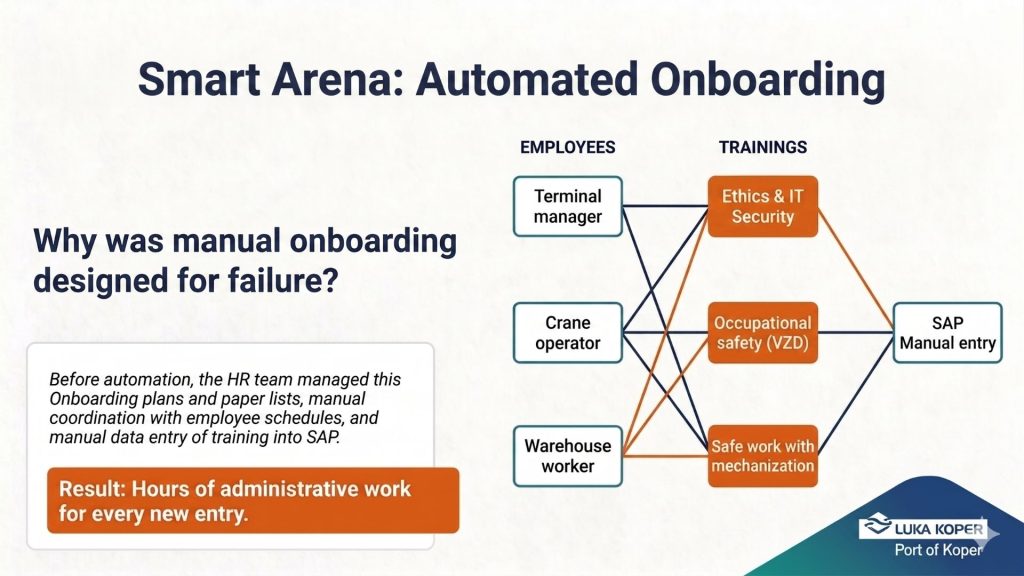
The reason shift-based onboarding breaks down is the matrix: role × unit × location × shift pattern. Each combination requires a different set of mandatory training — safety certifications, compliance modules, role-specific procedures. Before automating, document every branch of that matrix.
This doesn’t need to be perfect on day one. It needs to be explicit enough that a system can read it and make decisions without human intervention.
2. Connect your HRIS as the trigger
Automation only works if it starts at the right moment. The trigger should be a new hire record appearing in your HR system — not an email, not a calendar entry, not someone remembering to click a button.
Connect your LMS or onboarding platform directly to your HRIS (SAP, Workday, BambooHR, etc.) via API or native integration. When a new hire is created in the system, the automation fires: role is read, training path is assigned, access is provisioned.
This is the step most organisations skip, and it’s why their “automated” onboarding still requires manual kickoffs.
3. Build role-specific paths, not a single course
One generic onboarding course is worse than no automation at all — people ignore it, skip it, or complete it without retaining anything relevant to their job.
Use the complexity matrix from step one to build branching learning paths. A forklift operator and a terminal supervisor at the same company need completely different training sequences. The system should know the difference and assign accordingly, without HR making that call each time.
4. Design for deskless access from the start
Shift workers often don’t have a dedicated desk, a work email, or scheduled time in front of a computer. If your onboarding assumes otherwise, completion rates will be low regardless of the automation behind it.
Mobile-first delivery — accessible via phone, with a defined completion window (30 days is common) — removes the logistical friction. Terminal kiosks can serve as fallback for roles where phone access is restricted.
5. Automate compliance renewals, not just initial onboarding
Onboarding automation that stops after day 30 solves half the problem. Occupational safety certificates expire. Legal compliance training repeats on fixed cycles. If those renewals are tracked manually, the administrative burden returns on schedule — every year, forever.
Treat compliance as a loop, not an event. The system should hold the renewal date, calculate when re-enrolment is due (typically 3 months in advance), trigger the process automatically, and record the new completion back to your HRIS — without anyone managing a spreadsheet or sending reminder emails. Both parties — employee and safety engineer — should be able to sign digitally within the same flow, so there’s no paper handoff to process afterward.
What this looks like in practice
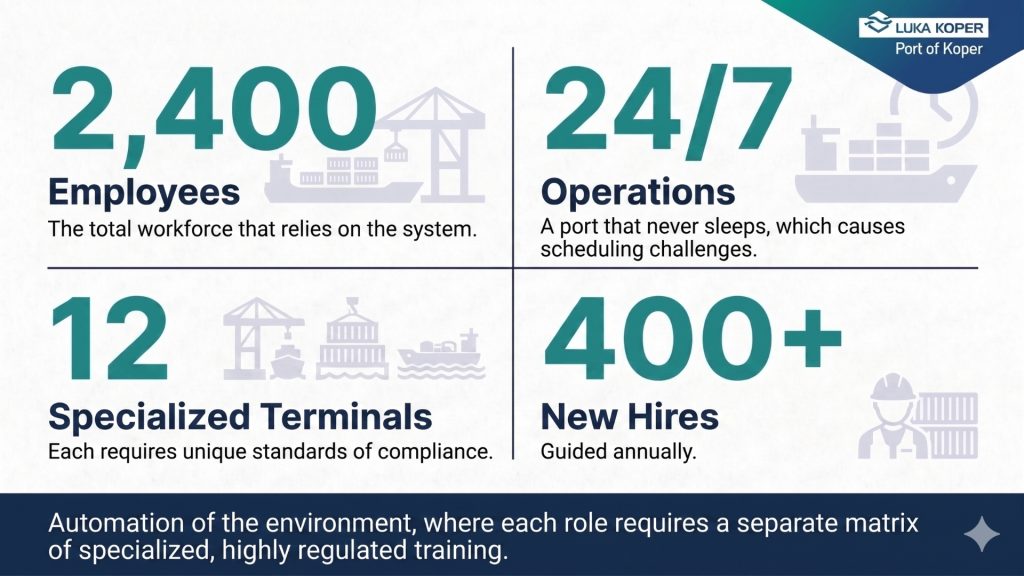
Port of Koper — Slovenia’s main cargo port, 2,400+ employees, 12 specialized terminals operating 24/7 — ran into exactly this problem. In 2024, they made a strategic decision to cut reliance on external agencies, which meant bringing 417 new employees in-house in a single year. Their existing manual system — printed onboarding plans, 4-hour live safety lectures, attendance sheets typed into SAP by hand — had no chance of scaling.
They rebuilt it with a two-way SAP integration and 120+ automated workflows. When a new hire is added to SAP, an account is created automatically via SSO, and the system assigns a personalized learning path based on role, unit, and location — no HR intervention required. Employees complete modules via mobile (the Capsula app) or terminal workstations, within a 30-day window that fits around shift patterns.
The system runs two distinct compliance tracks. General HR onboarding handles corporate policies and information security as a one-time event. Occupational health and safety (VZD) — legally mandated, cyclically renewed — runs as a closed loop: e-courses, a practical test with a safety engineer, digital signatures from both parties, and automatic re-enrolment when the next renewal date arrives.
The results: 480 digital onboardings in 2024 with exactly 0 manual data entries. Onboarding time dropped. And despite the speed increase, training quality held. Faster and more thorough, not faster at the expense of thorough.
The full case study is here: How Port of Koper automated onboarding for 417 new hires
The short version
Automating shift-based onboarding isn’t one tool or one step. It’s a connected system: HRIS as the trigger, role logic as the engine, mobile delivery as the interface, and renewal automation as the maintenance layer.
Get those four pieces talking to each other and the coordination bottleneck disappears — regardless of how fast you’re hiring.